The phone rings. I pick it up out of habit and am met with a rush — one of those high-speed, rehearsed sales voices that barrel through every polite interruption. I tell the caller, as calmly as I can, that I’m not interested and ask not to be called again. The voice doesn’t slow. It keeps talking, as if dialogue were impossible and only monologue permitted. I hang up, irritated — and oddly moved to reflection.
How often, I wondered, do we do the same to our dogs?
Not the affectionate back-and-forths that stitch our days together, but the one-sided torrent: ordering, chiding, assuming comprehension. Dogs approach us for connection — a nudge, a look, an invitation to be noticed — and we reply with a stream of human assumptions. We talk at them, not with them.
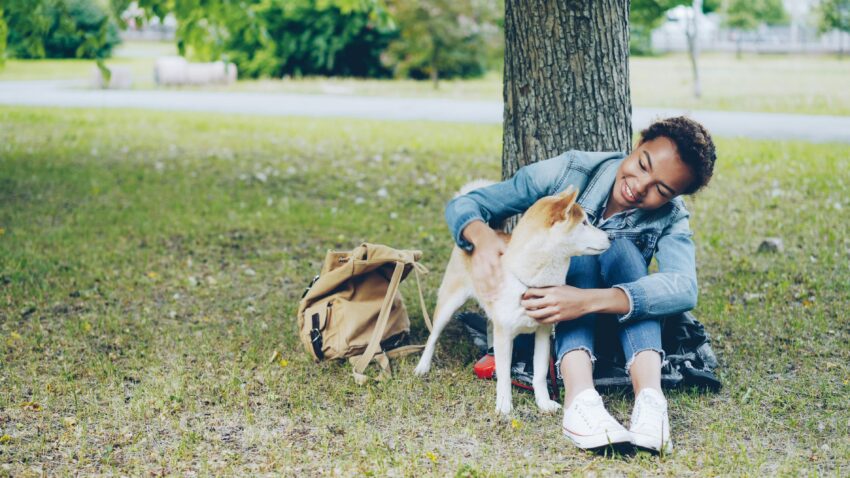
A small scene will make this plain. Last night Rio padded over while I was reading. She curled into the unoccupied crescent of the sofa — the perfect, quiet gesture of companionship. I began to catalogue her day aloud, a private litany: the walk, the squirrel encounter, the treat she’d clumsily accepted. I was fishing, admittedly, for a verbal answer. Rio’s reply was not words; she made herself a small, contented bundle and exhaled into the space beside me. Our conversation ended in mutual tranquility. I returned to my book, and to me that was enough.
So what does talking at a dog look like in practice? It is assuming the dog understands every sentence, confusing chance responses for true learning, and swapping precise cues for interchangeable chatter. We might say “stop” to halt movement, and “enough” to silence barking — from our perspective those are similar requests. From a dog’s perspective they are different. To them a sound is a sign only insofar as we have taught it to be consistent and meaningful.
This is where mindfulness becomes essential. Mindfulness is not merely slowing down; it is the practice of remembering the other being in front of you — their sensory world, their learning style, and their need for clarity. When we slow our speech and sharpen our cues, our dogs respond more reliably and feel less anxious about guessing our intent.
Below are practical, simple ways to move from talking at your dog to speaking with them:
- Use fewer, clearer cues. One short word for one action — and use that same word consistently. Ambiguity is the enemy of learning.
- Pair words with body language. Dogs read posture and motion before vocabulary. Match a verbal cue with a consistent gesture or position.
- Reward clarity, not luck. Reinforce the precise behavior you want immediately. This helps a dog attach meaning to your words rather than to random timing.
- Respect tone. Your voice is information. Softer, lower tones invite calm; livelier, brighter tones encourage play and movement. The same sentence said in different tones will mean different things to your dog.
- Adopt the “jolly-routine.” For uncertain meetings or potentially stressful moments, a matter-of-fact, pleasantly upbeat tone signals safety. This “happy” voice can reassure a tentative dog and even convince you — if only for a moment — that all is well.
- Practice presence. Before you speak, take a beat. Look at your dog, register their body language, then give a clear, intentional cue.
I am not arguing we must become silent or that words never matter. Dogs can and do learn verbal cues. But words alone, untethered to consistent signals and patient teaching, become noise. If we want our dogs to understand — and to cooperate without fear — our obligation is to be exact, predictable, and mindful.
So tonight, when your dog sidles up, try a different rhythm. Resist the urge to narrate. Pause. Notice. Speak one tidy phrase. Match it with a calm gesture. Watch what happens.
You may find, as I did with Rio, that the most satisfying conversations are not those filled with words, but those where both participants feel heard.